Joy as if reborn, the final eye surgery is Respect!
Respect Revision Eye Surgery
After accurately analyzing the cause of the failure, you are reborn with beautiful eyes through a customized surgical method.
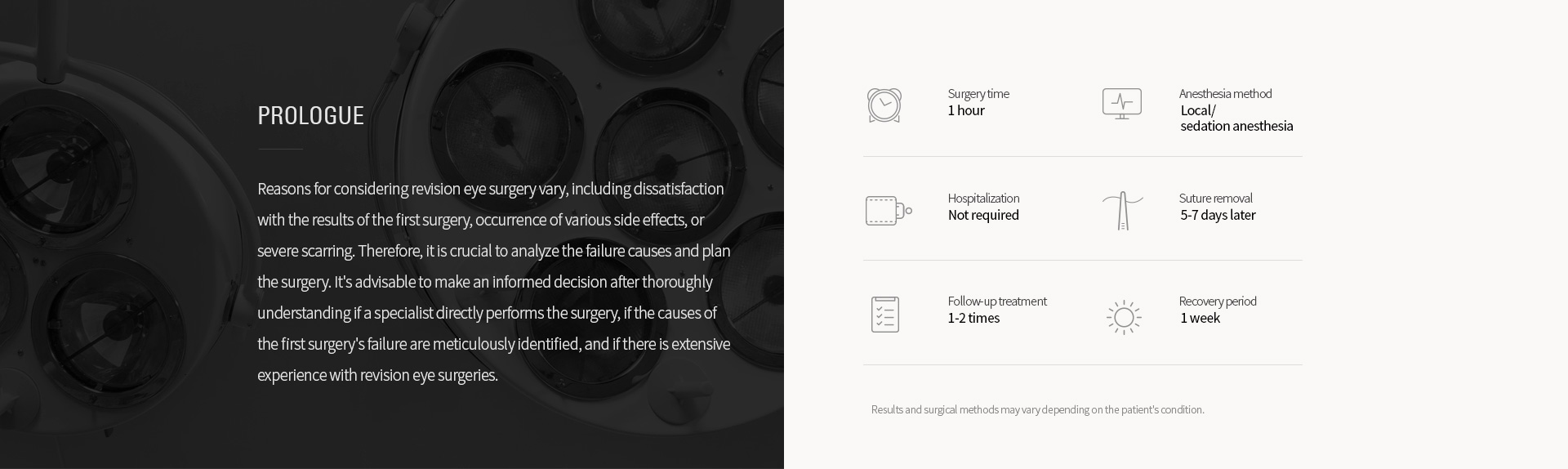
PROLOGUE
Reasons for considering revision eye surgery vary, including dissatisfaction with the results of the first surgery, occurrence of various side effects, or severe scarring. Therefore, it is crucial to analyze the failure causes and plan the surgery.
It's advisable to make an informed decision after thoroughly understanding if a specialist directly performs the surgery, if the causes of the first surgery's failure are meticulously identified, and if there is extensive experience with revision eye surgeries.
Surgery time: 1 hour
Anesthesia method: Local/sedation anesthesia
Hospitalization: Not required
Suture removal: 5-7 days later
Clinic visits: 1-2 times
Recovery period: 1 week
Results and surgical methods may vary depending on the patient's condition.
Click to overlap views!
Overlap
Revision eye surgery (3 months later)
Revision eye surgery, natural adhesion, quad canthoplasty 1 month
Postoperative complications such as bleeding, infection, and inflammation are common and can vary among individuals, so caution is necessary.
View more before and after photos
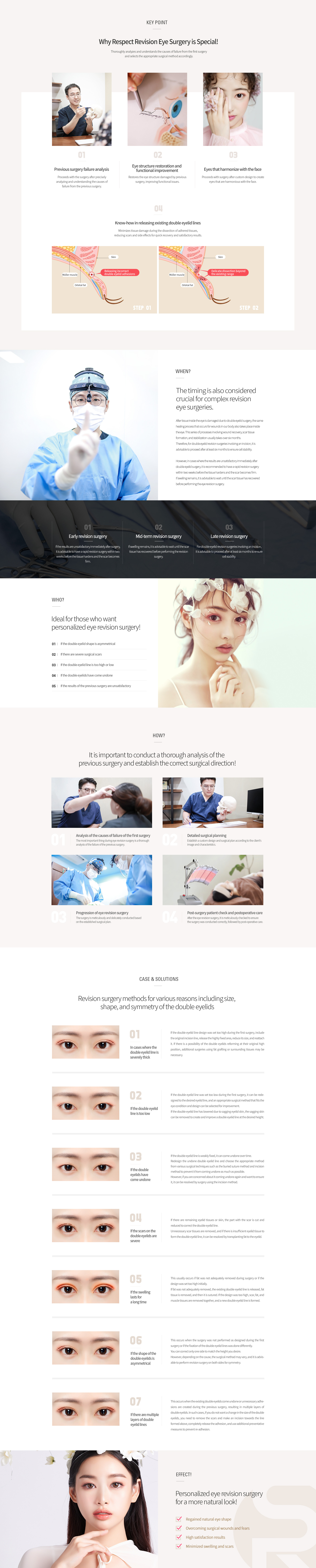
Why Respect Revision Eye Surgery is Special!
Thoroughly analyzes and understands the causes of failure from the first surgery and selects the appropriate surgical method accordingly.
Previous surgery failure analysis
Proceeds with the surgery after precisely analyzing and understanding the causes of failure from the previous surgery.
Eye structure restoration and functional improvement
Restores the eye structure damaged by previous surgery, improving functional issues.
Eyes that harmonize with the face
Proceeds with surgery after custom design to create eyes that are harmonious with the face.
Know-how in releasing existing double eyelid lines
Minimizes tissue damage during the dissection of adhered tissues, reducing scars and side effects for quick recovery and satisfactory results.
Müller muscle
Orbital fat
Skin
Releasing incorrect double eyelid adhesions
Delicate dissection beyond the existing range
The timing is also considered crucial for complex revision eye surgeries.
After tissue inside the eye is damaged due to double eyelid surgery, the same healing process that occurs for wounds in our body also takes place inside the eye.
This series of processes involving wound recovery, scar tissue formation, and stabilization usually takes over six months.
Therefore, for double eyelid revision surgeries involving an incision, it is advisable to proceed after at least six months to ensure cell stability.
However, in cases where the results are unsatisfactory immediately after double eyelid surgery, it is recommended to have a rapid revision surgery within two weeks before the tissue hardens and the scar becomes firm. If swelling remains, it is advisable to wait until the scar tissue has recovered before performing the eye revision surgery.
Early revision surgery
If the results are unsatisfactory immediately after surgery, it is advisable to have a rapid revision surgery within two weeks before the tissue hardens and the scar becomes firm.
Mid-term revision surgery
If swelling remains, it is advisable to wait until the scar tissue has recovered before performing the revision surgery.
Late revision surgery
For double eyelid revision surgeries involving an incision, it is advisable to proceed after at least six months to ensure cell stability.
Ideal for those who want personalized eye revision surgery!
01 | If the double eyelid shape is asymmetrical
02 | If there are severe surgical scars
03 | If the double eyelid line is too high or low
04 | If the double eyelids have come undone
05 | If the results of the previous surgery are unsatisfactory
It is important to conduct a thorough analysis of the previous surgery and establish the correct surgical direction!
Analysis of the causes of failure of the first surgery
The most important thing during eye revision surgery is a thorough analysis of the failure of the previous surgery.
Detailed surgical planning
Establish a custom design and surgical plan according to the client's image and characteristics.
Progression of eye revision surgery
The surgery is meticulously and delicately conducted based on the established surgical plan.
Post-surgery patient check and postoperative care
After the eye revision surgery, it is meticulously checked to ensure the surgery was conducted correctly, followed by post-operative care.
Revision surgery methods for various reasons including size, shape, and symmetry of the double eyelids
In cases where the double eyelid line is severely thick
If the double eyelid line design was set too high during the first surgery, include the original incision line, release the highly fixed area, reduce its size, and reattach it.
If there is a possibility of the double eyelids reforming at their original high position, additional surgeries using fat grafting or surrounding tissues may be necessary.
If the double eyelid line is too low
If the double eyelid line was set too low during the first surgery, it can be redesigned to the desired eyelid line, and an appropriate surgical method that fits the eye condition and design can be selected for improvement.
If the double eyelid line has lowered due to sagging eyelid skin, the sagging skin can be removed to create and improve a double eyelid line at the desired height.
If the double eyelids have come undone
If the double eyelid line is weakly fixed, it can come undone over time.
Redesign the undone double eyelid line and choose the appropriate method from various surgical techniques such as the buried suture method and incision method to prevent it from coming undone as much as possible.
However, if you are concerned about it coming undone again and want to ensure it, it can be resolved by surgery using the incision method.
If the scars on the double eyelids are severe
If there are remaining eyelid tissues or skin, the part with the scar is cut and reduced to correct the double eyelid line.
Unnecessary scar tissues are removed, and if there is insufficient eyelid tissue to form the double eyelid line, it can be resolved by transplanting fat to the eyelid.
If the swelling lasts for a long time
This usually occurs if fat was not adequately removed during surgery or if the design was set too high initially.
If fat was not adequately removed, the existing double eyelid line is released, fat tissue is removed, and then it is sutured.
If the design was too high, scar, fat, and muscle tissues are removed together, and a new double eyelid line is formed.
If the shape of the double eyelids is asymmetrical
This occurs when the surgery was not performed as designed during the first surgery or if the fixation of the double eyelid lines was done differently.
You can correct only one side to match the height you desire.
However, depending on the cause, the surgical method may vary, and it is advisable to perform revision surgery on both sides for symmetry.
If there are multiple layers of double eyelid lines
This occurs when the existing double eyelids come undone or unnecessary adhesions are created during the previous surgery, resulting in multiple layers of double eyelids.
In such cases, if you do not want a change in the size of the double eyelids, you need to remove the scars and make an incision towards the line formed above, completely release the adhesion, and use additional preventative measures to prevent re-adhesion.
Personalized eye revision surgery for a more natural look!
Regained natural eye shape
Overcoming surgical wounds and fears
High satisfaction results
Minimized swelling and scars
Before and after photos
Revision eye surgery (3 months later)
Frontal view
Postoperative complications such as bleeding, infection, and inflammation are common and can vary among individuals, so caution is necessary.
ㅡ Postoperative complications such as bleeding, infection, and inflammation are common and can vary among individuals, so ㅡ
RESPECT
SELFIE
beautiful change
CUSTOMER CENTER
Main number : 82-2-532-0888
Clinic Hours
Mon/Tue/Wed/Fri
AM 10 : 00 ~ PM 7 : 00
Thursday
AM 10 : 00 ~ PM 9 : 00
Saturday
AM 10 : 00 ~ PM 4 : 00
(Closed on Sundays and public holidays.)