My last nosejob, with no more failures!
Respect Revision Rhinoplasty
If you've decided on a revision rhinoplasty, Respect can address your concerns with experience and expertise.
PROLOGUE
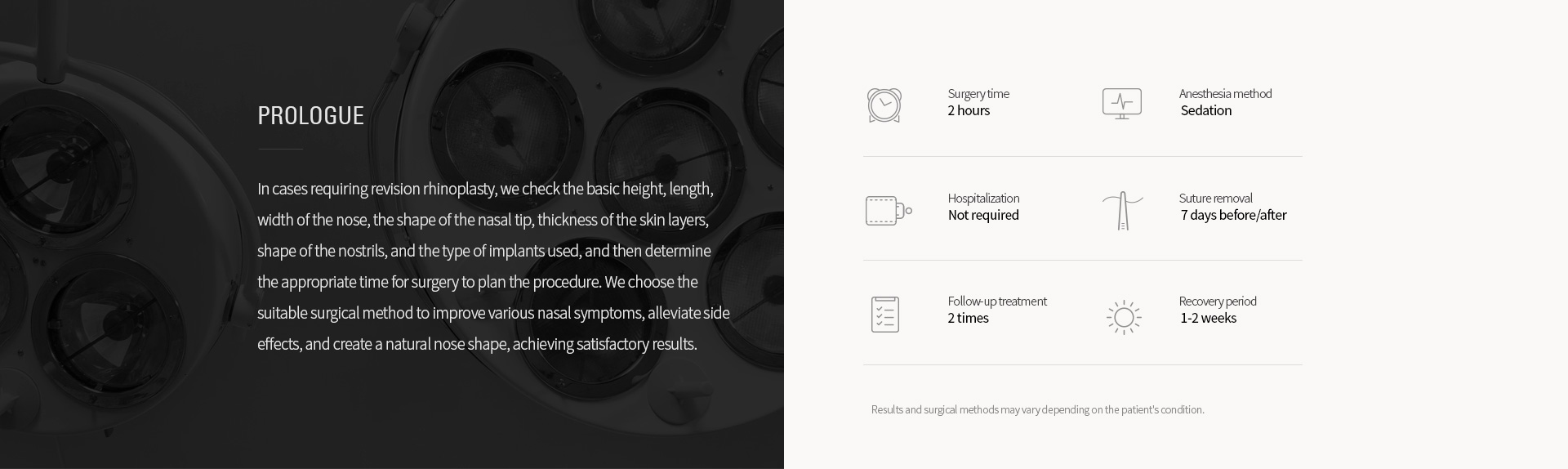
In cases requiring revision rhinoplasty, we check the basic height, length, width of the nose, the shape of the nasal tip, thickness of the skin layers, shape of the nostrils, and the type of implants used, and then determine the appropriate time for surgery to plan the procedure.
We choose the suitable surgical method to improve various nasal symptoms, alleviate side effects, and create a natural nose shape, achieving satisfactory results.
Surgery time: 2 hours
Hospitalization: Not required
Clinic visits: 2 times
Anesthesia method: Sedation
Suture removal: 7 days before/after
Recovery period: 1-2 weeks
Results and surgical methods may vary depending on the patient's condition.
※ Results may differ based on individual circumstances.
Click to overlap views!
Overlap
Philtrum Nose (Revision), Philtrum Reduction
Philtrum Nose (Revision)
Philtrum Nose (Revision), Philtrum Reduction, Corners of the Mouth
Postoperative complications such as bleeding, infection, and inflammation are common and can vary among individuals, so caution is necessary.
View more before and after photos
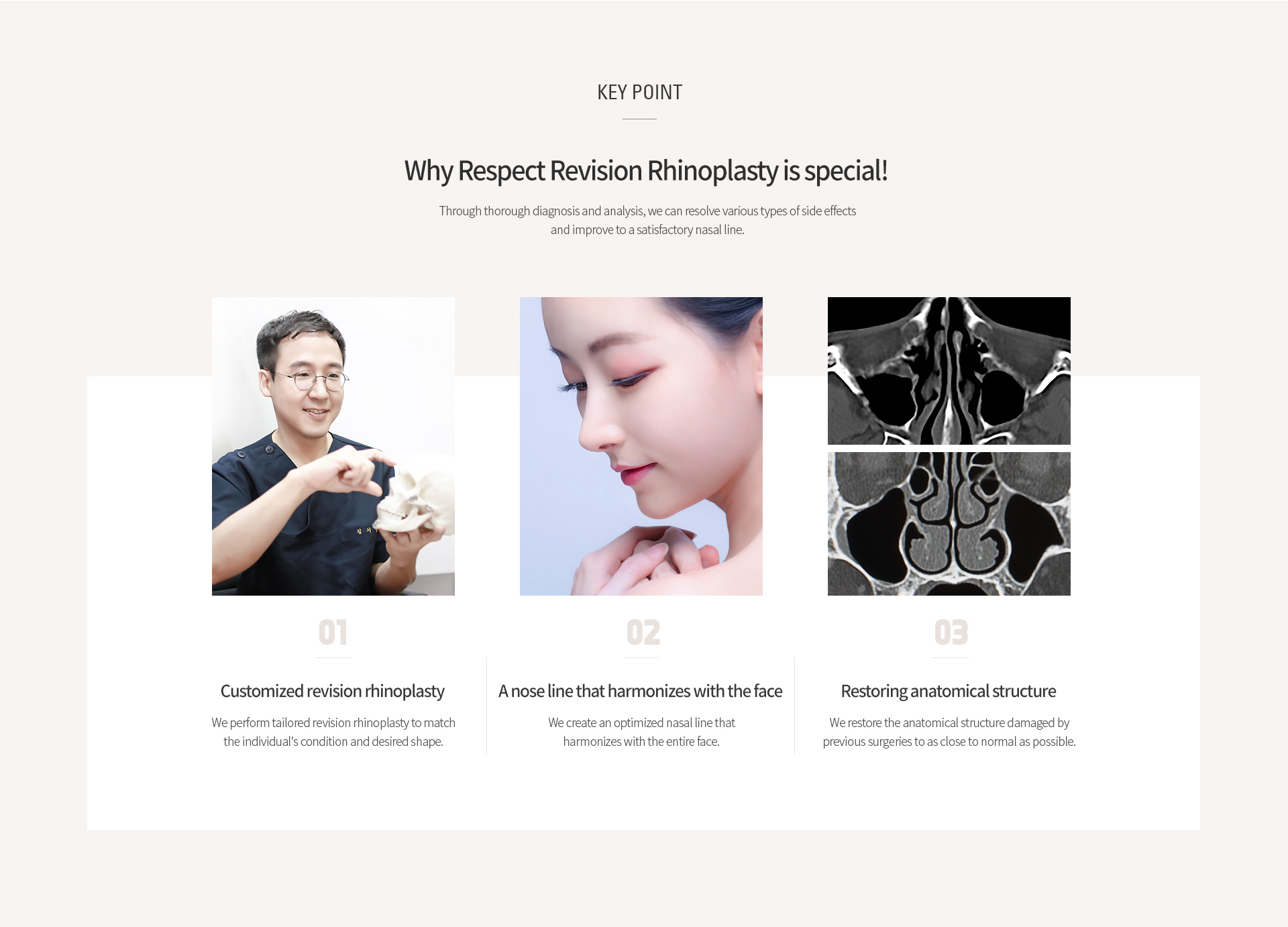
Why Respect Revision Rhinoplasty is special!
Through thorough diagnosis and analysis, we can resolve various types of side effects and improve to a satisfactory nasal line.
Customized revision rhinoplasty
We perform tailored revision rhinoplasty to match the individual's condition and desired shape.
A nose line that harmonizes with the face
We create an optimized nasal line that harmonizes with the entire face.
Restoring anatomical structure
We restore the anatomical structure damaged by previous surgeries to as close to normal as possible.
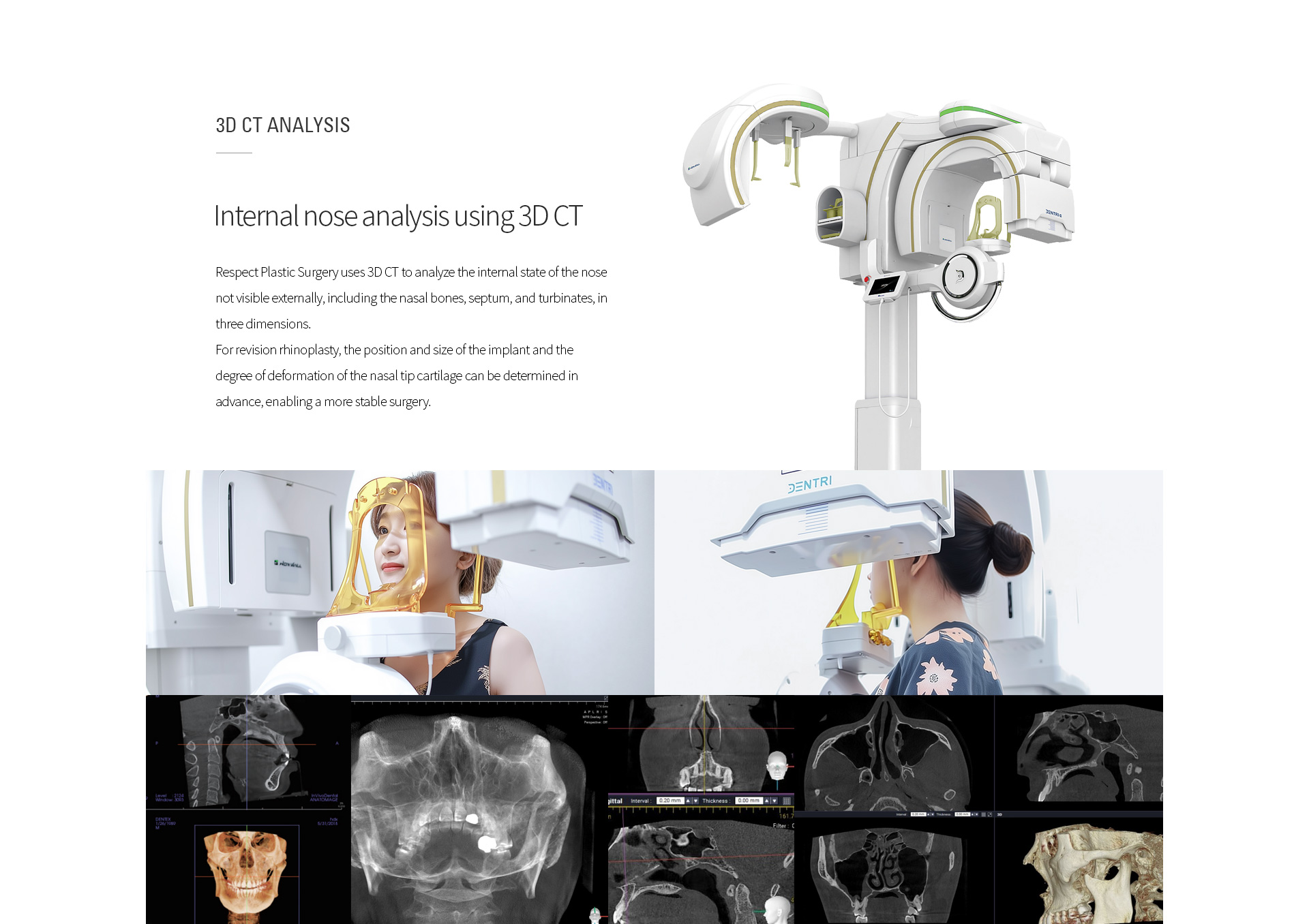
Internal nose analysis using 3D CT
Respect Plastic Surgery uses 3D CT to analyze the internal state of the nose not visible externally, including the nasal bones, septum, and turbinates, in three dimensions.
For revision rhinoplasty, the position and size of the implant and the degree of deformation of the nasal tip cartilage can be determined in advance, enabling a more stable surgery.
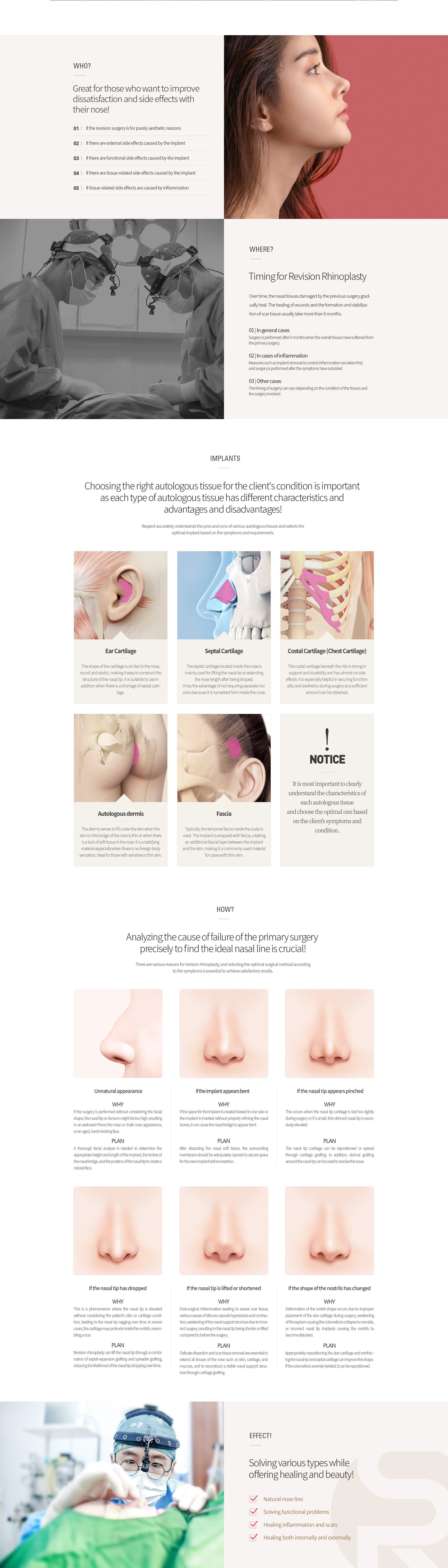
Great for those who want to improve dissatisfaction and side effects with their nose!
01 | If the revision surgery is for purely aesthetic reasons
02 | If there are external side effects caused by the implant
03 | If there are functional side effects caused by the implant
04 | If there are tissue-related side effects caused by the implant
05 | If tissue-related side effects are caused by inflammation
Timing for Revision Rhinoplasty
Over time, the nasal tissues damaged by the previous surgery gradually heal.
The healing of wounds and the formation and stabilization of scar tissue usually take more than 6 months.
01 | In general cases
Surgery is performed after 6 months when the overall tissues have softened from the primary surgery.
02 | In cases of inflammation
Measures such as implant removal to control inflammation are taken first, and surgery is performed after the symptoms have subsided.
03 | Other cases
The timing of surgery can vary depending on the condition of the tissues and the surgery involved.
Choosing the right autologous tissue for the client's condition is important as each type of autologous tissue has different characteristics and advantages and disadvantages!
Respect accurately understands the pros and cons of various autologous tissues and selects the optimal implant based on the symptoms and requirements.
Ear Cartilage
The shape of the cartilage is similar to the nose, round and elastic, making it easy to construct the structure of the nasal tip.
It is suitable to use In addition when there is a shortage of septal cartilage.
Septal Cartilage
The septal cartilage located inside the nose is mainly used for lifting the nasal tip or extending the nose length after being shaped.
It has the advantage of not requiring separate incisions because it is harvested from inside the nose.
Costal Cartilage (Chest Cartilage)
The costal cartilage beneath the ribs is strong in support and durability and has almost no side effects.
It is especially helpful in securing functionality and aesthetics during surgery as a sufficient amount can be obtained.
Autologous dermis
The dermis serves to fill under the skin when the skin on the bridge of the nose is thin or when there is a lack of soft tissue in the nose.
It is a satisfying material especially when there is no foreign body sensation, ideal for those with sensitive or thin skin.
Fascia
Typically, the temporal fascia inside the scalp is used.
The implant is wrapped with fascia, creating an additional fascial layer between the implant and the skin, making it a commonly used material for cases with thin skin.
It is most important to clearly understand the characteristics of each autologous tissue and choose the optimal one based on the client's symptoms and condition.
Analyzing the cause of failure of the primary surgery precisely to find the ideal nasal line is crucial!
There are various reasons for revision rhinoplasty, and selecting the optimal surgical method according to the symptoms is essential to achieve satisfactory results.
Unnatural appearance
WHY
If the surgery is performed without considering the facial shape, the nasal tip or dorsum might be too high, resulting in an awkward Pinocchio nose or chalk nose appearance, or an aged, harsh-looking face.
PLAN
A thorough facial analysis is needed to determine the appropriate height and length of the implant, the incline of the nasal bridge, and the position of the nasal tip to create a natural face.
If the implant appears bent
WHY
If the space for the implant is created biased to one side or the implant is inserted without properly refining the nasal bones, it can cause the nasal bridge to appear bent.
PLAN
After dissecting the nasal soft tissue, the surrounding membrane should be adequately opened to secure space for the new implant before insertion.
If the nasal tip appears pinched
WHY
This occurs when the nasal tip cartilage is tied too tightly during surgery or if a small, thin-skinned nasal tip is excessively elevated.
PLAN
The nasal tip cartilage can be repositioned or spread through cartilage grafting. In addition, dermal grafting around the nasal tip can be used to resolve the issue.
If the nasal tip has dropped
WHY
This is a phenomenon where the nasal tip is elevated without considering the patient's skin or cartilage condition, leading to the nasal tip sagging over time. In severe cases, the cartilage may protrude inside the nostrils, resembling a scar.
PLAN
Revision rhinoplasty can lift the nasal tip through a combination of septal expansion grafting and spreader grafting, reducing the likelihood of the nasal tip dropping over time.
If the nasal tip is lifted or shortened
WHY
Post-surgical inflammation leading to severe scar tissue, various causes of silicone capsule hyperplasia and contraction, weakening of the nasal support structure due to incorrect surgery, resulting in the nasal tip being shorter or lifted compared to before the surgery.
PLAN
Delicate dissection and scar tissue removal are essential to extend all tissues of the nose such as skin, cartilage, and mucosa, and to reconstruct a stable nasal support structure through cartilage grafting.
If the shape of the nostrils has changed
WHY
Deformation of the nostril shape occurs due to improper placement of the alar cartilage during surgery, weakening of the septum causing the columella to collapse to one side, or incorrect nasal tip implants causing the nostrils to become distorted.
PLAN
Appropriately repositioning the alar cartilage and reinforcing the nasal tip and septal cartilage can improve the shape. If the columella is severely twisted, it can be repositioned.
Solving various types while offering healing and beauty!
Natural nose line
Solving functional problems
Healing inflammation and scars
Healing both internally and externally
Before and after photos
Philtrum Nose (Revision), Philtrum Reduction
Frontal view
Postoperative complications such as bleeding, infection, and inflammation are common and can vary among individuals, so caution is necessary.
※ Results may vary depending on individual circumstances.
ㅡ Postoperative complications such as bleeding, infection, and inflammation are common and can vary among individuals, so ㅡ
RESPECT
SELFIE
beautiful change
CUSTOMER CENTER
Main number : 82-2-532-0888
Clinic Hours
Mon/Tue/Wed/Fri
AM 10 : 00 ~ PM 7 : 00
Thursday
AM 10 : 00 ~ PM 9 : 00
Saturday
AM 10 : 00 ~ PM 4 : 00
(Closed on Sundays and public holidays.)